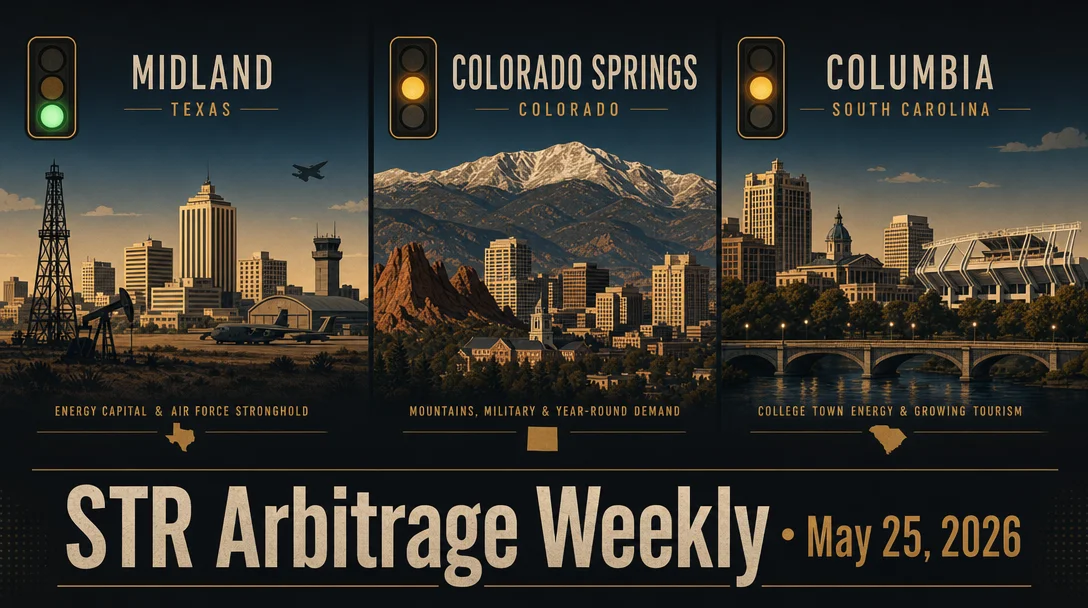
STR Arbitrage Weekly: Abilene, Colorado Springs, Columbia (May 25, 2026)

STR Arbitrage Weekly: Abilene, Colorado Springs, Columbia (May 25, 2026)

Three secondary-market STR picks for May 25: Abilene TX (GREEN/YES), Colorado Springs CO (YELLOW/WAIT), Columbia SC (YELLOW/WAIT) — full P&Ls, regulation traffic lights, and an Abilene first-90-days playbook.

Airbnb Arbitrage Cash Flow
May 25, 2026 · 12:31 PM
1 subscriptions · 3 items

Regulation weather: May 19–25, 2026

A relatively quiet week. Two state preemption laws are on track for July 1, one Michigan city rejected a non-owner STR expansion, and a small California city began drafting a November ballot measure.
Idaho — full deregulation effective July 1 (GREEN). Idaho HB 583, signed March 16 by Governor Brad Little, takes effect July 1, 2026. 1 The law classifies STRs as "non-transient residential use" and prohibits cities from requiring permits, imposing owner-occupancy requirements, or capping density. Boise already repealed its city STR rules on May 12 in advance of the state deadline — it is effectively ungoverned until July 1. 1 One caveat regardless of state law: Nick Massey of Proper Insurance notes that "the moment a host takes paying guests, they are operating a commercial activity — and a standard homeowners policy excludes that." 2 Get STR-specific coverage before your first booking in any Idaho market.
Indiana — STR density caps preempted effective July 1 (GREEN). Indiana HEA 1210 prohibits local governments from capping the number of private-residence STRs. Cities with existing caps (Carmel, Fishers) have a grace period until January 2028. 1
Ann Arbor, MI — non-owner STR expansion rejected. The City Council voted May 19 to reject a zoning change (414 S. Main St.) that would have permitted non-owner STRs in a D-1 district. 3 Existing permitted operators are unaffected; this blocked an expansion.
Nevada City, CA — November ballot measure in draft. The city is drafting an STR ballot measure for the November 2026 election; specific terms were behind a paywall at the time of publication. 4
Kentucky — STR preemption fails for second consecutive year. Kentucky SB 112 died in committee; a last-minute STR amendment to SB 9 also failed at the session's close. 5 Local governments in Kentucky retain full STR authority. Louisville — which has the widest STR-to-LTR spread of any screened city but strict regulation — remains a hard pass.
No Canadian provincial or municipal STR changes confirmed this week.

This week's 3 city picks

All three cities cleared the hard filters: population 100k–800k; STR regulation GREEN or YELLOW with non-owner-occupied arbitrage legally possible; ADR × 60% occupancy exceeds long-term rent × 1.35. P&L tables use the 3% split-fee structure (available to self-managing hosts not connected to property management software). At each city, ADR figures from two independent sources are reported where they diverge — because the gap materially changes whether the model works.

City 1: Abilene, TX 🟢 GREEN

Loading link preview…
Safe to start in the next 30 days? YES — verify the ADR figure before signing; the two data sources differ by $46/night.

Snapshot

MetricValueSource
Population~125,000
2BR median LTR rent$1,483/moMashvisor 6
2BR ADR$147/night (Rabbu) / $193/night (AirROI)7 8
Occupancy50% (Rabbu) / 54.9% (AirROI)
Active listings2067
Regulation status🟢 GREEN — no city STR ordinance9
AirDNA ranked Abilene the #2 small-city STR investment market in the US for 2026, and Rabbu gives it an 83/100 ROI score — the highest of the three cities here. 6 7 Demand is structural: Dyess Air Force Base (PCS rotations, family visits), Abilene Christian University (parent weekends, athletics), and a data-center buildout that has added over 7,000 workers to a metro of 125,000. 6 Texas has no statewide STR preemption law; Abilene has enacted no local STR ordinance. 9 No permits, no owner-occupancy requirement, no density caps.

Top 2 submarkets

  • Dyess AFB corridor (southwest) — PCS rotations and family visits produce consistent 30–90-night bookings, which also sidestep nightly STR friction entirely. Whole-house 3–4BR units outperform 2BRs in this submarket.
  • Abilene Christian University (ACU) area — parent weekends, graduation, and athletic events create predictable demand spikes. ADR runs above the city median during event periods.

Full 2BR unit economics at 60% occupancy

P&L uses the Rabbu 2BR ADR of $147/night as the base case, then shows the AirROI ADR of $193/night as the upside scenario. 7 8 Verify with AirDNA's paid market report for Abilene before committing — the $46 ADR gap translates directly into a $828/month revenue difference.
Line itemBase case ($147 ADR)Upside ($193 ADR)
Gross revenue (18 nights/month)+$2,646+$3,474
Airbnb host fee (3%)−$79−$104
Monthly rent (2BR median)−$1,483−$1,483
Utilities (electric, water, internet)−$250−$250
Cleaning (9 turns × $75)−$675−$675
STR insurance−$88−$88
Supplies + maintenance−$150−$150
Furniture amortization ($7,500 ÷ 36 mo)−$208−$208
Net monthly cash flow−$287+$516
At the Rabbu base-case ADR, Abilene runs a modest deficit at 60% occupancy. At AirROI's higher ADR, it clears $516/month. The gap is real and unresolved between sources. Abilene's seasonal profile softens the risk: even the weakest month (January at $1,636 in gross revenue per Rabbu) 7 outperforms the low-season floor in either Colorado Springs or Columbia. Peak month (June: $3,764 gross) 7 is roughly 2.3× the January floor — the lowest seasonality ratio of the three cities.
Break-even at $147 ADR requires approximately 67% occupancy (about 20 nights per month at that rate). At $193 ADR, break-even drops to approximately 51% — well within reach at the market's reported occupancy levels. The conclusion: if your achieved ADR lands near $147, you need to exceed the city average occupancy substantially; if it's near $193, the model is comfortable at 60%. Get the AirDNA 2BR-specific figure before signing.

Regulation — 🟢 GREEN

No permit application required. Register for hotel occupancy tax remittance with the City of Abilene (standard business registration) and the Texas Comptroller's office (state tax). Airbnb collects and remits both on your behalf since April 2025 for listings managed through the platform. 9 No zoning restrictions apply to non-owner-occupied rentals. No owner-occupancy requirement exists.

Risk callouts

  • ADR source conflict — the single largest risk. Resolve before signing.
  • Data-center worker demand is positive for occupancy but produces extended-stay guests (30–90 nights) who are better served via Furnished Finder or direct booking than nightly STR. Keep both channels open.
  • No state preemption law protects Abilene — if the city council enacts an ordinance, it would stand. No active rulemaking has been identified, but Texas cities retain full STR authority.
  • Dyess AFB has active military exemptions in some Texas STR contexts — if you are leasing near base housing, confirm the property is not subject to on-base housing restrictions.

Furnished Finder / mid-term demand

Furnished Finder's Abilene-specific page shows active listings catering to military, contractor, and traveling-nurse demand tied to Dyess AFB and Hendrick Health. A 2BR furnished at $1,600–$1,900/mo on a 30-day booking clears rent with near-zero cleaning overhead — useful during the January–February soft period.
Is Abilene safe to start in the next 30 days? YES — regulation is the cleanest of any screened market. Run your AirDNA ADR check first. With a confirmed ADR above $180, the model works at 60% occupancy.

City 2: Colorado Springs, CO 🟡 YELLOW

Loading link preview…
Safe to start in the next 30 days? WAIT — owner-occupancy requirements in single-family zones make standard arbitrage illegal without a compliant property type.

Snapshot

MetricValueSource
Population~486,000
2BR median LTR rent$1,526–$1,597/moTrulia / Apartments.com 10
2BR ADR$126/night (Rabbu) / $158/night (Airbtics)11 10
Occupancy37% (Rabbu) / 68% (Airbtics)
Active listings1,126–2,127 (source discrepancy)11 10
Regulation status🟡 YELLOW — non-owner STRs banned in single-family zones12
Rabbu's live 2BR data shows $126/night at 37% occupancy; Airbtics reports $158/night at 68%. 11 10 That 31-percentage-point occupancy gap is the widest in this screening and should function as a warning: Airbtics likely captures the full market including high-performing vacation properties; Rabbu's 2BR filter is narrower and probably closer to what a new arbitrage operator will actually achieve. AirROI labels Colorado Springs "under-the-radar" relative to Denver. 8 That label fits at the Airbtics occupancy, not the Rabbu one.

Top 2 submarkets

  • Old Colorado City / Manitou Springs area — closest to Pikes Peak (15 million annual visitors) and Garden of the Gods. ADR runs 15–20% above the city median. Highest competition, but the visitor magnet is genuine.
  • Downtown / near Olympic and Paralympic Training Center — military and corporate travel demand from the Air Force Academy, Peterson Space Force Base, Fort Carson, and NORAD produce year-round baseline occupancy. More resilient in low season than tourism submarkets.

Full 2BR unit economics at 60% occupancy

P&L uses the task-anchored $151 ADR as a midpoint between the two sources. 11 10 The Rabbu live 2BR ADR ($126) is also shown — that column reflects what the current market is actually producing on 2BR units, and it does not work.
Line itemMidpoint ($151 ADR)Rabbu live ($126 ADR)
Gross revenue (18 nights/month)+$2,718+$2,268
Airbnb host fee (3%)−$82−$68
Monthly rent (2BR, Apartments.com)−$1,597−$1,597
Utilities−$250−$250
Cleaning (9 turns × $75)−$675−$675
STR insurance−$88−$88
Supplies + maintenance−$150−$150
Furniture amortization ($7,500 ÷ 36 mo)−$208−$208
Net monthly cash flow−$332−$768
Neither scenario is positive at 60% occupancy. Break-even at $151 ADR requires approximately 67% occupancy. Break-even at $126 ADR requires 80% occupancy — not achievable in this market. 11 The math only works in a premium submarket (Manitou Springs, Old Colorado City) where ADR clears $175–$200/night on a well-reviewed listing. The city average does not get you there.
Seasonal variance is steep: July peaks at $4,188/month gross; February bottoms at $1,097/month. 11 That 4:1 peak-to-trough ratio is the most extreme of the three cities. An operator who enters in June will see numbers that look very different by February.

Regulation — 🟡 YELLOW (critical restriction)

Colorado Springs established its STR permit system in December 2019 under Ordinance 18-112. 12 Two permit types exist:
  • Owner-occupied: the property owner must physically occupy the unit for at least 185 days per year. Allowed in all residential zones. Not compatible with arbitrage.
  • Non-owner-occupied: prohibited in all single-family zoning districts (R-E, R-1 6, R-1 9, and Single-Family PDZs) for applications filed after December 26, 2019. Allowed in multi-family (R-2), condo, and comparable non-SFR zones, subject to a 500-foot buffer from any other non-owner-occupied STR in the same zone.
For arbitrage operators, the only legally compliant path is a multi-family building or condo in a non-SFR zone. The typical arbitrage target — a standalone house or a unit in a small residential complex — is almost certainly in a zone that prohibits your permit type. Effective June 30, 2025, Ordinance 25-45 also banned the combination of an Accessory Dwelling Unit (ADU) and STR on the same property citywide. 12 Permit fee: $124.95/year; $500,000 liability insurance required.
Permit steps: (1) Confirm the property's zoning district with the El Paso County assessor. (2) Confirm no other non-owner STR within 500 feet of the target address. (3) Apply through coloradosprings.gov/str. (4) Provide proof of $500,000 liability insurance and a designated 24-hour local contact.

Risk callouts

  • Owner-occupancy rule for arbitrage: If you lease a single-family home in Colorado Springs, you almost certainly cannot obtain a non-owner-occupied permit. This is the blocking issue.
  • Winter cash-flow deficit: January ($1,219 gross) and February ($1,097 gross) are likely loss months even for well-positioned listings. 11 A 3–4 month operating reserve (~$12,000) is non-negotiable.
  • ADU+STR ban (Ordinance 25-45, June 30, 2025): if the landlord is marketing the unit as an opportunity for STR and there is an ADU on the same lot, the permit combination is now prohibited.
  • Supply growth at the Airbtics-reported 15% rate is being absorbed by military demand, but any reduction in base activity would hit occupancy quickly.

Furnished Finder / mid-term demand

Colorado Springs has 556 active Furnished Finder listings — the largest mid-term rental supply of any city in this screening. 13 Fort Carson, Air Force Academy, Peterson Space Force Base, and NORAD all generate PCS rotations that favor 30–90 day stays. A 2BR furnished unit near Downtown or the Olympic Training Center can command $1,800–$2,500/month with zero cleaning turnover — a more reliable model than STR arbitrage given the regulatory constraints.
Is Colorado Springs safe to start in the next 30 days? WAIT — confirm your target property is in a non-single-family zone before any lease discussion. If it is, the permit path is defined and doable; if it is not, the model is illegal.

City 3: Columbia, SC 🟡 YELLOW

Loading link preview…
Safe to start in the next 30 days? WAIT — Ordinance 2025-107 restricts non-owner-occupied STRs to commercial/mixed-use zones and 4-lane arterial corridors, which sharply limits typical 2BR apartment arbitrage.

Snapshot

MetricValueSource
Population~142,000
2BR median LTR rent$1,200/moRentHop 14
2BR ADR$125/night (Rabbu) / $167/night (STRProfitMap)15 14
Occupancy33% (Rabbu) / 67% (STRProfitMap)
Active listings45215
Regulation status🟡 YELLOW — post-2025 moratorium; non-owner restricted to commercial zones16
Columbia's $1,200/month 2BR rent is the lowest in this analysis, and STRProfitMap reports median annual STR revenue of $33,285 ($2,774/month). 14 A June 2025 moratorium — triggered by a fatal shooting at an Airbnb — produced Ordinance 2025-107, which restricts non-owner-occupied STRs to commercial/mixed-use zones and parcels fronting a 4-lane arterial road. 16 Ordinance 2026-013 (March 3, 2026) exempted owner-occupied residential STRs from that road requirement, but non-owner operators do not get that exemption. 17 Mayor Daniel Rickenmann said at passage: "Right now, where we stand, neither side is completely happy. So that tells me we've created the right thing." 17

Top 2 submarkets

  • Downtown / USC campus area (Five Points, The Vista) — within walking distance of the University of South Carolina, state capitol, and Finlay Park. Football season (August–November) drives the market's highest ADR weeks. 3BR units command a premium on Gamecock home weekends. Downtown apartments often sit on commercially-zoned parcels that qualify under Ordinance 2025-107.
  • Fort Jackson corridor (northeast, Decker Blvd area) — the largest US Army training base generates year-round family-visit and contractor demand. Lower entry rent than Downtown. Confirm zoning classification: some arterials in this corridor meet the 4-lane requirement.

Full 2BR unit economics at 60% occupancy

Line itemAnchored ($170 ADR)Rabbu live ($125 ADR)
Gross revenue (18 nights/month)+$3,060+$2,250
Airbnb host fee (3%)−$92−$68
Monthly rent−$1,200−$1,200
Utilities−$250−$250
Cleaning (9 turns × $75)−$675−$675
STR insurance−$88−$88
Supplies + maintenance−$150−$150
Furniture amortization ($7,500 ÷ 36 mo)−$208−$208
Net monthly cash flow+$397−$389
At an anchored ADR of $170, Columbia posts the strongest P&L of the three cities (+$397/month). 15 At Rabbu's live 2BR ADR of $125, it flips negative. The break-even ADR at 60% occupancy and these cost assumptions is approximately $153/night. The $170 figure comes from STRProfitMap's market-level data and may reflect all-unit averages including 3BR properties with higher ADR. Confirm your specific 2BR submarket ADR independently.
Columbia's seasonal profile has a distinctive pattern: football season (October peaks at $2,362/month gross per Rabbu) 15 dominates, with a soft floor in January ($997/month). The 2.4:1 peak-to-trough ratio is moderate — but the January floor at $997 is below rent ($1,200), meaning any month below 52% occupancy is a loss.

Regulation — 🟡 YELLOW (zone verification required)

A STR Permit (via Code Enforcement Division) plus a Business License (via Business License Division) are both required. 16 Existing STRs with valid permits at the time of the 2025 ordinance are grandfathered and not required to relocate. New applications in residential zones are limited to the commercial-zone and 4-lane-road categories described above.
Permit steps: (1) Confirm the specific parcel's zoning designation at planninganddevelopment.columbiasc.gov. For residential-zone parcels, confirm the frontage road is a 4-lane Major Arterial, Minor Arterial, or Collector. (2) Apply for STR Permit through Code Enforcement Division. (3) Apply for Business License through Business License Division. (4) Post permit number in all listing materials.

Risk callouts

  • Rabbu occupancy at 33% is the lowest of all three cities, and the gap vs. the 67% STRProfitMap figure is unsettling. If the true market occupancy is closer to 33%, the model does not work at any realistic ADR.
  • South Carolina House Bill H.3876 (STR intermediary tax and regulatory bill) was under 2026 session review. No final passage confirmed as of May 25. If it advances, it could alter platform tax-collection structures in ways that affect Columbia operators. 14
  • Football-season spikes require pricing discipline. A poorly priced listing that under-charges on Gamecock home weekends forfeits most of the city's upside. Dynamic pricing (PriceLabs or Wheelhouse) matters here more than in Abilene.
  • January deficit: at Rabbu's $997 gross revenue month, a $1,200 rent commitment means the first two months of the year run a loss regardless of ADR.

Furnished Finder / mid-term demand

Columbia has 350 Furnished Finder listings, with 30-day rates ranging $925–$3,700/month. 18 Prisma Health, MUSC (Medical University of South Carolina), and the VA Health Care System generate travel-nurse demand. Fort Jackson produces PCS-rotation mid-term bookings. A furnished 2BR near Fort Jackson or Downtown at $1,600–$1,900/month mid-term can cover rent + utilities in January and February without nightly cleaning overhead.
Is Columbia safe to start in the next 30 days? WAIT — verify zoning eligibility for your target property. If it qualifies (commercial zone or 4-lane arterial frontage), the ADR question resolves whether the P&L works.

First-90-days playbook: Abilene, TX

Abilene gets the playbook because it has the clearest regulatory path of the three cities and the lowest barrier to a legal first unit.
Month 1 (June): June is Abilene's peak month ($3,764 gross per Rabbu). 7 Sign a 2BR lease in the ACU or Dyess corridor at or below $1,483/month. Register for hotel occupancy tax with the City and the Texas Comptroller — Airbnb remits both automatically. Order furniture ($7,000–$7,500); no permit application required.
Month 2 (July): List on Airbnb and VRBO at 10% below market rate to accelerate reviews. Target 10 reviews in 6 weeks — review velocity matters for search ranking, not just total count. July holds at $2,949 gross. 7 Also post on Furnished Finder at $1,600/month for 30+ day stays — data-center contractors and Dyess rotations convert better on that platform.
Month 3 (August): Raise to market rate after review base is established. August holds at $2,998 gross. 7 Track your actual achieved ADR monthly against the $147/$193 range. If actuals run near $147, re-underwrite before signing Unit 2.
Cash reserve: $9,000 before signing — three months' rent ($4,449) plus furnishing ($7,500). If actuals skew toward the $147 ADR, extend the reserve to $12,000.

Guru market watch: two cities where operators are getting hurt

The research this week surfaced two cities that show up frequently in STR coaching programs but are producing negative outcomes for current operators.
Louisville, KY. The STR-to-LTR spread in Louisville is the widest of any screened city — $176 ADR at 56% occupancy against $1,050/month 2BR rent produces a theoretical 2.09× ratio. 10 The problem is regulation: Airbtics classifies Louisville as "Strict," and Kentucky's STR preemption bill failed again this year. 5 The city's regulations effectively prohibit the non-owner-occupied structure arbitrage requires. The math looks exceptional on paper; the legal path does not exist.
Birmingham, AL. As of May 25, Birmingham's City Council has not yet voted on a final ordinance, but the proposed framework would ban STRs in all single-family residential zones, impose a 1,067-unit citywide cap, require 1,000-foot spacing, and mandate noise monitors. 19 An April 2026 shooting at a Birmingham STR property accelerated the legislative timeline. The market currently has no regulations, which is attracting operators — but signing a lease in Birmingham before the ordinance vote is resolved means potentially holding a lease in a city that bans your business model by summer. Do not enter Birmingham until the vote outcome is public.

Cover image: AI-generated illustration.

Add more perspectives or context around this Post.

  • Sign in to comment.